
“The way we’re thinking about this year is to let Shinnecock be Shinnecock,” USGA’s chief competitions officer John Bodenhamer said to Doug Ferguson of The Associated Press last week.
What a novel idea. Let one of the best golf courses in the world stand up to the best golfers in the world and see who wins — and do it without the foolishness that the USGA can bring to the U.S. Open.
Thankfully, Bodenhamer is a thoughtful and logical man, and when he says something, I tend to believe him. Unfortunately, the USGA has a history with Shinnecock Hills that does not give me warm-and-fuzzy feelings.
The 2004 Horror Show
In 2004, the USGA finally went back to Long Island after Corey Pavin’s miraculous 4-wood in 1995, which brought him his only major title. Pavin won at even par, as did Raymond Floyd in 1986. Considering that James Foulis was the only other winner, back in 1896 at 8 over par in a 36-hole event, it is fair to say that Shinnecock is one tough golf course.
But 2004 was unique, with players struggling on an unfairly thought-out setup. The weekend was a horror show, with only 11 players shooting par or better in the final two rounds. On Sunday, only Robert Allenby recorded a par-70 round, as the scoring average ballooned to 78.73.
Tiger Woods did not temper his frustration with the setup after his final round.
“You can see some of the putts, I mean, they're just not staying on the greens,” Woods said. “It's terrible, our national championship; they lost control of the golf course. There's nothing wrong with a guy being under par; there's nothing wrong with that. If they play well, they deserve to be under par, but not like this; this is not the way it's supposed to be played.”
Retief Goosen went on to win in 2004, but luck was a much bigger part of the equation than it should have been. Yet Walter Driver, chairman of the USGA Championship Committee, and Mike Davis, USGA championship director, were responsible for the setup on the front nine that Sunday.
Driver blamed the weather:
“This is a very difficult wind; it did dry out, it became very difficult, but we start setting courses up for championships four and five years in advance, and you cannot change an Open course setup in 12 hours,” Driver said. “It's not possible. So we went from having lots of compliments for what we did for three days, and then the wind blew harder and in a different direction than we anticipated, and you simply can't go redo the greens in 12 hours.”
History Repeats Itself in 2018
After the disaster of 2004, the USGA promised that the mistakes were in the past, spending most of the next 14 years telling anyone who would listen that it wouldn’t happen again.
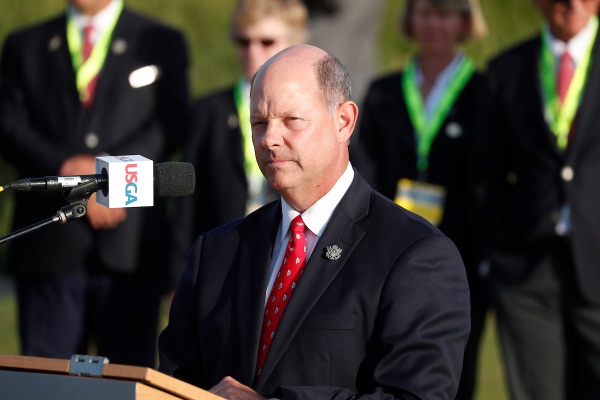
“In a lot of cases, we've tried to put hole locations where the wind might blow uphill. But I think that, you know, relative to 2004 — listen, here's what I would say — different time, 14 years ago,” said Davis, then CEO and head of U.S. Open course setup, before the 2018 Open. “There's a lot more science to this. Even though golf course setup is still an art, we look at moisture levels, and meteorology is better; we have firmness levels and speed levels. So I think that we want this to be a true test of golf, where every aspect of your game is tested. To some extent, the golf course and the USGA can do its part, and Mother Nature can do her part. She's got a seat at the table, as we like to say, and we're confident this should be a marvelous test.”
Despite all the assurances of a proper setup, third-round putts were rolling off greens just as they had in 2004. Players were incensed, and tempers were frayed. Phil Mickelson even hit a moving ball as it rolled off the green, showing utter contempt for the setup and the USGA.
“We felt that it would work well given the forecast we had, but I think that, now that I'm sitting here, we would say that parts of this test of golf simply were too tough,” Davis said after the third round. “We want the U.S. Open to be tough, but we saw some examples late in the day where well-executed shots were not only not being rewarded, but in some cases penalized. And specifically, I think the one that was the most troublesome was the 15th green, that hole location. It worked fine most of the day, but it didn't work fine later in the day.”
Davis went on to explain that the high winds dried out the greens. While he didn’t say it in so many words, they had lost the golf course again.
Looking Ahead to 2026
Two Opens and two disasters.
Bodenhamer, who was involved in the setup of the 2018 Open, took a more active role in setup duties in 2019 as Davis relinquished the role.
So now it's Bodenhamer’s baby: not necessarily to right the wrongs of 2004 and 2018, but to ensure 2026 isn't added to the list of U.S. Open disasters.
Eventually,